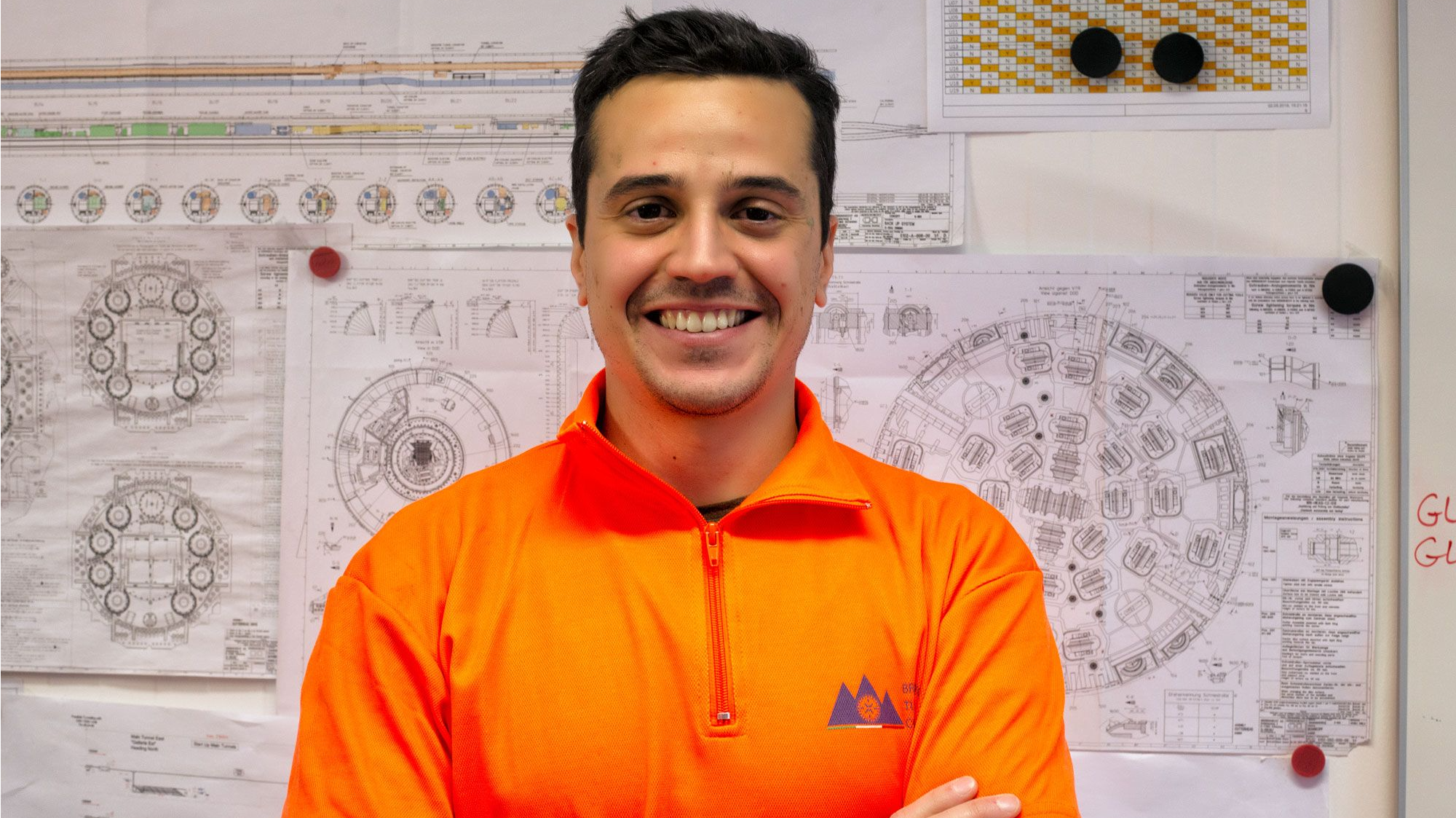
Brennero Tunnel Construction (Astaldi-Ghella-Pac-Cogeis JV): Alberto Paddeu
Young Tunneller of the Year
Information
The Brennero Tunnel Construction Scarl (Astaldi-Ghella-Pac-Cogeis JV) is the general contractor for the biggest lot inside the Brenner Base Tunnel.
The Mules 2-3 Lot consists in the construction of the last Italian link before reaching the Italian-Austrian border. This means that BTC's TBMs will connect, for the future generations, the two countries at 1,700 m below the Alps.
About this entry
Entry Title
Brenner Base Tunnel - Lot Mules 2-3
Brief Overview of Entry
Once completed, the Brenner Base Tunnel (BBT) Project will mark the record as the world longest railway tunnel, connecting Innsbruck in Austria and Fortezza in Italy, with 64 km long complex underground infrastructure.
The mechanized tunnelling works are characterized by the complexity of the geology encountered, these difficulties are emphasized by the complicated logistic and the challenging underground activities.
The TBMs have crossed fault zones with high risk of caving phenomena at depths up to 1,600 m, likewise they have crossed rock formations marked by squeezing phenomena, nonetheless they are also prepared to excavate, in extremely hard and abrasive rocks.
Long Description of Entry
The Brenner Base Tunnel is considered an iconic project in the tunnelling industry for its complexity and for the benefits it will produce to the citizens of the European Union. Therefore, at the Mules 2-3 Lot, the biggest Lot of the BBT project, technical problems had to be tackled with innovative solutions by the application and adaptation of different techniques which are standard in other branches of the Engineering but are considered a State-of-Art in TBM tunnelling.
Firstly, the innovation towards the TBM tunnelling industry is achieved by applying a procedure specifically developed for this Lot. Collaborating with consultants, we had systematically employed a Blow-Out-Preventer (BOP), which is an equipment largely used in the oil extraction industry to control possible leakages from submarine deep wells. The JV used this equipment to mitigate the high risk of water resources depletion, while executing bore holes for geological recognition purposes from inside the TBM of the Exploratory Tunnel. The BOP currently used is able to control eventual water inflows at high pressures to preserve precious water resources. This procedure is considered a main advantage towards the local communities and the environment because is intended to preserve these waters, like the Brenner Thermal Waters, since they play a fundamental role in the equilibrium of the Alps’ biodiversity.
Traditional tunnelling methods, such as Drill & Blast, were used to release the TBM’s shields from squeezing rocks. The JV completed in 30 days the construction of a rescue tunnel by-pass on the TBM used to excavate the Exploratory Tunnel. Several challenges were encountered from a geological point of view since the tunnel was constructed at 1,600 m depth in complex geological conditions and from a logistics point of view because was located 8 km away from the entry portal.
An innovative solution was needed when the TBM used for the excavation of the Northwest Main Tunnel encountered a geological fault zone characterized by weathered rock mass. Therefore, to proceed with excavation it was needed to execute a consolidation campaign at 1,300 m depth and 5 km inside the tunnel. Therefore, JV adapted the equipment and a standard technique used for slope stabilisation, which implicates to use casing à manchette pipes and eccentrical drill bits. However, these equipment and technique are not common on mechanized tunnelling. Exceptional results where achieved with this innovative solution when used from inside a TBM.
Another example of innovation towards the tunnelling industry was achieved when it was employed the hydrodemolition, which is a standard technique in concrete demolition. BTC JV used this method to reduce the frictional forces between the TBM’s shield and rock. The hydrodemolition is characterized by its simplicity because it only needs: a water pump, a high-pressure hose, a rotating nozzle and passing holes through the TBM’s shields to install the nozzle. The hydrodemolition was conducted in a period of only 7 days, afterwards the TBM was able to proceed with excavation, improving the JV’s work schedule towards the Client. This innovative solution avoided a standard practice employed in hard rock tunnelling with TBMs, like a rescue lateral by-pass, which results in a complex and inevitably time-consuming method.
About this category
About
Nominations for this award are sought to find the individual who, while developing and deepening his or her experience in the tunnelling industry, has made an outstanding contribution between January 2019 and July 2020.
Judges will focus on the personal contribution made by the individual to successfully bring to market innovative ideas or initiatives, challenge normal practices or lead major technically complex operations.
About category sponsor
About
Spie Batignolles fondations is one of the largest specialist foundation contractors in Europe. The Company operates in both the infrastructure and building markets, including rail, water, power, highways and multi-storey buildings.
Our ethical and collaborative approach, coupled with a high level of technical and operational resources, means the Company is chosen to deliver major infrastructure and building projects both in Europe and further afield.
With our wealth of experience both in the UK, across Europe, Africa and the Middle East, the Company is ideally placed to offer innovative solutions.